September 5, 2025
Edtech Done Right: The North Star


September 5, 2025
Edtech Done Right: The North Star
At Project RISE, Akanksha’s flagship initiative for nurturing students with exceptional academic potential from under-resourced communities, we strive to make learning authentic, joyful, and rigorous. Recently, during an Earth Science intensive, we used technology to transform how students experienced astronomy.
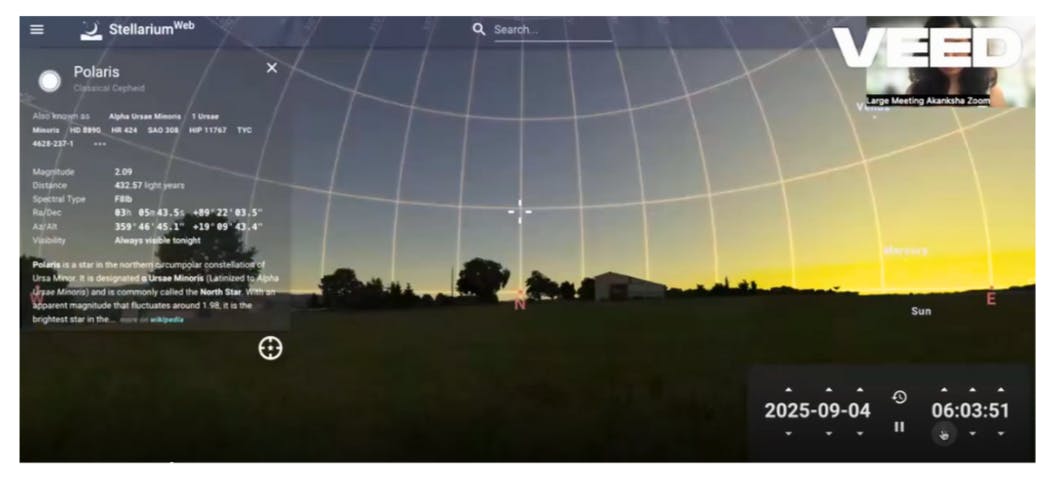
Using Stellarium, a free, open-source virtual planetarium, students could simulate the night sky, compress months of observation into minutes, and view the positions of stars and planets from different latitudes — all from their school computers.
Our first exploration revolved around the North Star (Polaris). With Stellarium, students uncovered patterns that would otherwise take months (and an expensive telescope) to notice:
The North Star appears stationary while other stars and planets move.
Its height above the horizon changes with location — climbing higher in the north and sinking closer to the horizon near the equator.
We designed the activity knowing that students often come in with gaps or misconceptions about the night sky. Many had never heard of the North Star, or assumed it must be the brightest star. Others thought all stars move in the same way. Stellarium allowed them to test these assumptions for themselves. The realization that the North Star appears fixed — unlike the Sun, Moon, or planets — became a powerful entry point into scientific thinking. It led students to ask: If it can serve as a guide in the Northern Hemisphere, what about the Southern Hemisphere? And how would we recognize the North Star in the real night sky?
That curiosity is the essence of science. And it is also a reminder of what good EdTech can do when thoughtfully applied.
Access: Free, open-source tools let students engage in authentic inquiry without telescopes or dark skies.
Authenticity: Students practiced science — observing, recording, analyzing — not just recalling.
Extension: Technology amplified capacity, compressing time and shifting perspectives, rather than digitizing old tasks.
When used this way, technology doesn’t just deliver content. It redefines what students can see, do, and wonder about.
Written By:
Sapna Shah, Program Head of Project Rise at The Akanksha Foundation
5
May/2023
Our Students Talk Tech With Tim
Last month, Apple CEO Tim Cook, visited our Sitaram Mill Compound schoo...

5
January/2022
Celebrating Akanksha’s Teachers, School Teams and Staff Members With Our Annual Service Awards 2021
With the ongoing pandemic, all our activities may be directed online, but that did n...

29
October/2021
New Alumni Members on the Akanksha Board of Directors
At Akanksha, we prioritize having alumni members on our board to ensure the inclusion of student voices and involve them in strategic decision-making. At the March 2019 Boar...
